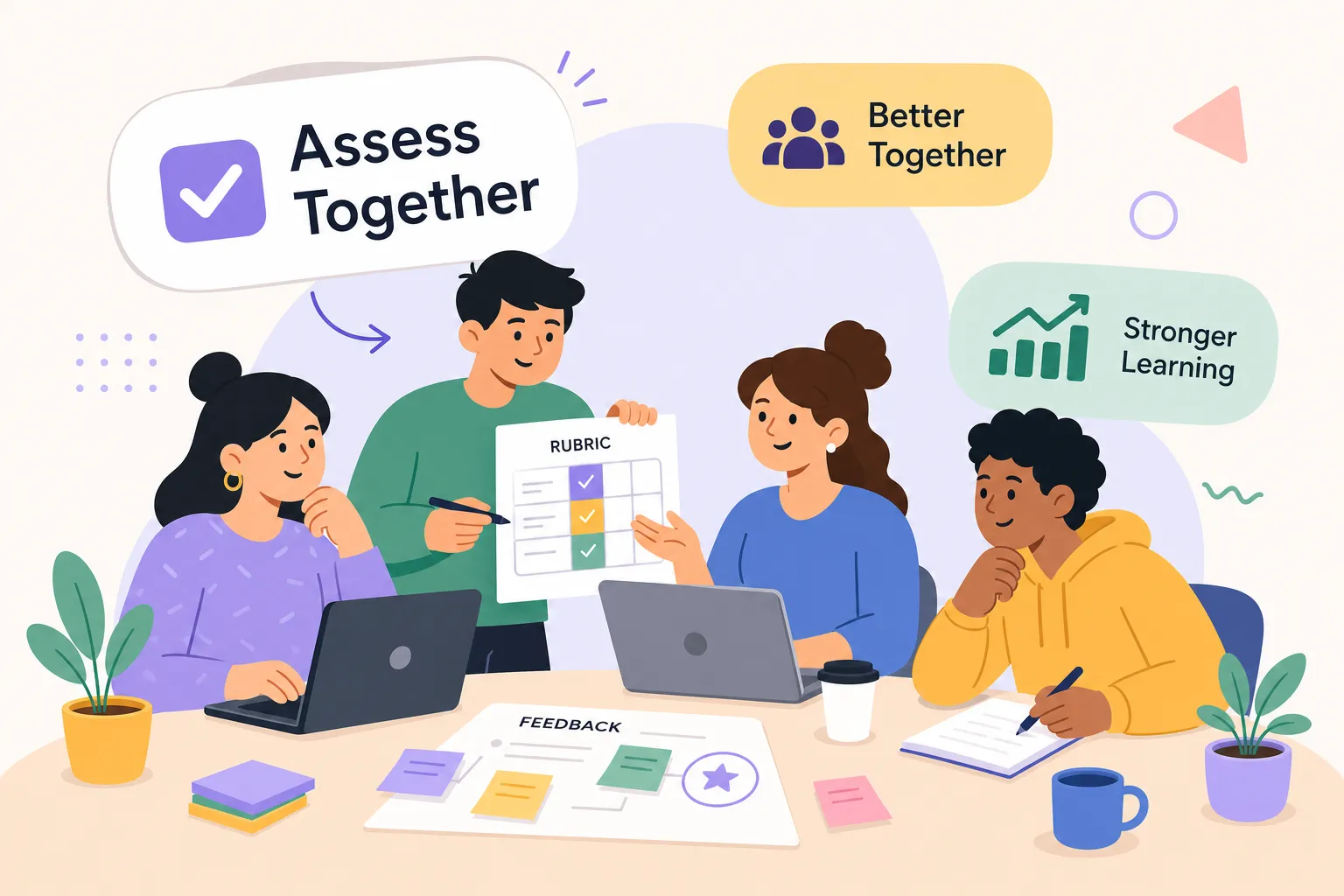
Collaborative assessment strategies rarely happen by accident. Most instructors assign group projects believing collaboration is built in. It usually isn't. A shared deadline and a shared Google Doc don't produce collaborative learning; they produce division of labor with a single grade slapped on top. One student drafts the report, another formats it, a third adds their name, and everyone walks away having learned something slightly different from what you intended.
The research on this is clear. A meta-analysis of 55 studies found peer assessment produces an overall effect of g = 0.31 on student learning outcomes, with online formats pushing that effect to Hedges's g = 0.672. But those gains only appear under specific conditions: structured criteria, student training, and the opportunity to revise. The version most instructors use, where students casually review each other's work without a rubric or follow-up, delivers none of those gains. At Teaching Business Communication, this is one of the most common gaps we see when instructors come to us looking to modernize how they grade group work.
This article gives you a practical framework for building collaborative assessment that holds up: rubric models, a step-by-step process, contribution tracking, and fixes for the problems that derail most implementations.
Why unstructured peer feedback rarely produces real learning
Walk into most business communication classrooms running peer review and you'll see the same thing: students scan a classmate's draft for five minutes and type "good intro, maybe add more detail." That's not feedback; it's social courtesy. Without shared criteria and explicit training, students default to vague encouragement or surface-level comments, both of which produce zero measurable learning gain for the reviewer or the recipient.
The structural problem is that peer review is treated as an activity rather than a process. Systematic reviews consistently find that formative peer assessment is the most effective format, but only when students receive explicit criteria, scaffolding, and the chance to revise based on what they receive. Multiple review cycles outperform one-off reviews. A single round of peer comments before a final submission doesn't give students enough time to internalize feedback and apply it, which is where the actual learning happens.
There's also a conceptual issue worth naming. Peer grading is summative and one-directional: student A evaluates student B and a score appears. Co-assessment is different. It involves students in building a shared understanding of what quality looks like before they evaluate anything. That shift, from "students marking each other" to "students developing shared standards and applying them", is what separates robust collaborative assessment methods from the version that frustrates both instructors and students.
Building a rubric that grades both the group and the individual
The most defensible rubric for group work is a two-part structure: one section scores the group product, another scores each individual's contribution. The group product criteria cover what the team produced together, content quality, organization, use of evidence, and professional communication. The individual contribution criteria cover what each student actually did: completing assigned tasks, participating in meetings, communicating with teammates, and following through on commitments.
Weighting group product versus individual contribution
A practical weighting is 60 to 80 percent on the group product and 20 to 40 percent on individual contribution. That balance keeps the collaborative deliverable central, which encourages real teamwork, while making free-riding costly enough that it shows up in a student's grade. It also gives strong contributors a place to earn credit even when their group's final product falls short of its potential.
The criteria you put on the individual side need to be observable and documentable. Phrases like "good team player" are too vague to score consistently and are almost impossible to defend in a grade dispute. Replace them with behaviors that leave a record:
- Completed assigned tasks by agreed deadlines
- Participated actively in team meetings and check-ins
- Responded to team communication within the established timeframe
- Contributed constructively to decision-making and problem-solving
- Supported teammates' ideas and provided useful feedback
Scoring levels and rubric rollout
For scoring levels, a four-point scale with parallel wording works well in post-secondary settings: Exemplary, Proficient, Developing, and Beginning. Write the descriptors in plain language and make sure the wording at each level is parallel across all criteria. Share the full rubric before the project starts, not as an afterthought the week it's due. Students who understand the criteria upfront produce better work, and the rubric holds more credibility as an assessment tool when it has been visible throughout the process.
Converting a group project using collaborative assessment strategies
The backbone of a strong collaborative assessment isn't the rubric; it's the procedure. Start with backward design: define what students should know or be able to do, then choose a task that actually requires collaboration to complete. A task that can be divided into independent parts and reassembled at the end isn't a collaborative task; it's a jigsaw. The best tasks for genuine collaborative assessment involve consensus-building, multi-perspective analysis, or problem-solving where disagreement is productive and the group has to work through it together.
Before students start working in groups, give them a brief individual thinking step: a short written response, a position statement, or an initial analysis they complete on their own. This gives you a baseline for each student's understanding and makes growth visible when you compare it to what they produce after the collaboration. It also prevents the group dynamic from immediately flattening individual thinking.
Assign roles with clear responsibilities for every group member: facilitator, recorder, checker, and reporter are four that map well to business communication tasks. Build in at least two mid-project checkpoints, either instructor check-ins, peer calibration rounds, or structured self-assessment pauses. These are not optional additions. They're what converts a group project into a valid team-based assessment by ensuring the collaborative process is assessed, not just the final product.
Finish with an individual follow-up measure. An exit ticket, a short quiz, a reflection entry, or a brief individual submission after the group product is handed in separates what the group produced from what each student actually understood. Formative collaborative feedback loops only close when there's individual accountability at the end of the cycle.
Documenting who actually did what
The most common reason instructors avoid assigning individual grades within group work is that they don't feel they have enough evidence to differentiate fairly. That's a solvable problem. Several tools generate a contribution record automatically and without additional instructor effort.
Google Docs and Microsoft 365 both have built-in version history and coauthor tracking, every edit is timestamped and attributed to a named account. Task boards like Trello or Asana record task ownership, status changes, and completion dates. Slack and Microsoft Teams archive discussion records, so coordination and decision-making are visible when groups use these platforms as their primary workspace. For courses with significant peer critique components, Peergrade is worth knowing: it's designed specifically for structured peer review with rubric support and anonymity options.
Pair those tools with two simple protocols. First, require a brief individual contribution log: after each working session, students record the task they worked on, what they produced, how long they spent, and their next step. Second, use meeting minutes with assigned action items and named owners. Both protocols are low-overhead for students and give you clear, attributable evidence when you need to differentiate grades. When peer-and-self assessment ratings are part of the picture, treat them as supporting evidence for the documented record rather than the primary source; the record comes first.
Supporting peer feedback in online and hybrid classrooms
Online and hybrid formats require a more deliberate setup because the informal accountability that exists in a physical classroom (students can see each other, read the room, gauge participation) doesn't transfer automatically to a digital environment. The LMS features that matter most are rubric-based peer review workflows, participation analytics, and anonymous review options when candid feedback is a priority over social accountability.
Tools worth adding to the stack
For business communication courses specifically, a few external tools earn their place. Padlet supports multimodal peer commenting and tends to reduce student anxiety compared to formal discussion boards, making it useful for brainstorming and early-stage critique. Kaizena enables voice feedback and inline commentary on documents, which is particularly relevant in courses where communication style and tone are part of what's being assessed. Flip supports video-based peer response for assignments where oral communication is part of the grade. Peergrade handles full peer-review cycles with structured setup, rubric integration, and multiple iteration rounds. Together, these tools extend the co-assessment techniques that work well in face-to-face settings into digital ones.
The anonymous-versus-named question comes up in every online implementation. Anonymous review works better for higher-stakes written critiques, early in the course when trust hasn't been established, and when you want feedback driven by criteria rather than social dynamics. Named review works better for final presentations, peer coaching relationships, and situations where professional accountability is itself a learning objective. Neither approach is always right; match the choice to the purpose of the assessment.
When collaborative assessment breaks down and what to do about it
Free-riding is the most common complaint, and the good news is that the rubric and the contribution log address it directly. If the evidence trail shows unequal effort, individual grades should reflect it. That's not punitive; that's accurate assessment. Mid-project checkpoints let you intervene before the imbalance compounds, which is far more useful to students than a post-hoc grade adjustment. A group contract agreed to at the start of the project sets expectations clearly and gives you a reference point if conflict arises.
Friendship bias in peer ratings is real but manageable. Anonymity reduces it without eliminating it; pair anonymous review with specific, criteria-based prompts rather than open-ended rating scales to push students toward evidence rather than impression. When peer ratings diverge significantly from the documented contribution record, that discrepancy is worth investigating before you factor the peer scores into a final grade.
Resistance to giving honest feedback almost always comes from one of two places: fear of social consequences or lack of confidence in their own evaluative judgment. Both are addressable. Start with low-stakes peer review early in the course, before anything significant is on the line, to build the habit and reduce the social risk. Frame co-assessment as a professional competency rather than a grading mechanism. Evaluating colleagues' work, giving specific constructive feedback, and receiving it without defensiveness are skills that employers across the U.S. consistently flag as gaps in new graduates, according to surveys. Telling students that directly tends to shift their approach.
Putting collaborative assessment strategies together
Effective collaborative assessment strategies work when they are structured, rubric-based, and paired with individual accountability. The practical arc is straightforward: start with a two-part rubric that separates group product from individual contribution, build checkpoints into the project timeline, document contributions using tools that generate their own evidence trail, and close the loop with an individual measure that confirms real understanding.
At Teaching Business Communication, we cover all of these areas in depth, including modern rubric design, collaborative learning structures, and digital tool integration for U.S. post-secondary contexts. If you're looking to update your assessment frameworks beyond traditional group grading, that's exactly what the platform is built for.
You don't need to overhaul your entire course at once. Pick two or three of these collaborative assessment strategies, run them consistently for a term, and watch what happens to both fairness and learning outcomes. The evidence is consistent: structure is what makes collaboration work.